

The History of the T-Shirt: From Humble Undergarment to Fashion Icon
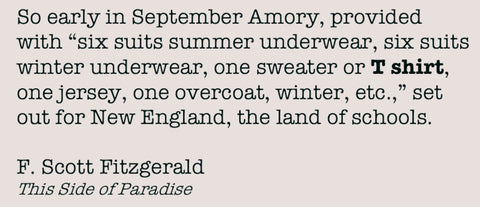
Even though the T-Shirt was inspired in the late 1800s, both the term and modern cotton tee we use in our daily life today didn’t enter our lexicon until 1920. It wasn’t until F. Scott Fitzgerald first used the term in This Side of Paradise that the modern T-Shirt became an everyday idea.
Think about that for a moment: the term has only been around for a little over 100 years, yet the T-Shirt has become ingrained in our society as an undeniable staple of everyone’s wardrobe. To put that in context, the crossword puzzle, bra, and parachute were all invented seven years earlier in 1913.
The T-Shirt owes its ongoing popularity to its unrivaled versatility, simplicity in design and relaxing comfort. The classic T is just as likely to be found under a blazer in a modern boardroom, as it is paired with shorts on a summer day at the beach.
We like to think that we have perfected the classic T, with our premium men’s Pima cotton T-Shirts, but clearly cannot claim to have invented it. Let’s dive into a quick history of the classic T-Shirt and how it has grabbed the hearts of shoppers everywhere…
Origins of the Classic T-Shirt
The first T-Shirt resembled footy pajamas more than actual adult clothing. In the late 1860s, union workers would wear something called a “union suit." This was a one-piece set of underwear that looked like what you would wrap your baby in today before putting them down for the night.

In the summertime, the men who were issued these union suits would cut off the bottoms to stay cool. This created a sort of primitive T-Shirt, like what we use today. Between the union suit and the early 1920s, classic T-Shirts began entering the manufacturing world. There were a few early thinkers who distributed pullover shirts that were buttonless.
The practicality of this kind of layer was introduced in the United States Navy. It was during the 1920s that the first T-Shirts were made from lightweight cotton material with short sleeves, crew necks, and no buttons. They were worn underneath the navy uniform and became a staple of that branch of the government.
As the years progressed, other industries saw the benefit of having such versatile clothing options for their workers. Everyone from minors in Virginia to agricultural workers in California, began to put on C because of the comfort and breathability of the cotton fabric. As more workers adopted the clothing garment, it soon became a staple of the working class.
The Role of Popular Culture
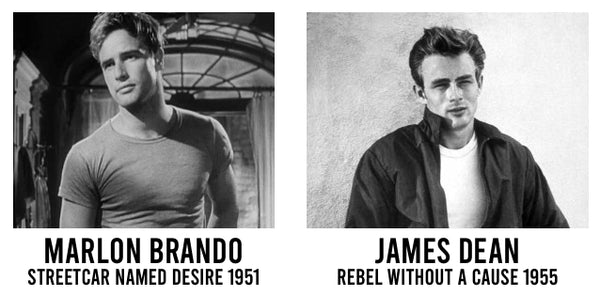
It wasn’t until the 1950s that the T-Shirt finally entered pop culture. This is when Marlon Brando famously walked around in the movie, A Streetcar Named Desire, thrusting his fist into the air and screaming for his love. This machismo representation of rebellion and counterculture became every young man’s dream, causing millions of Americans to toss on a classic T-Shirt.
Soon, you begin to see T-Shirts popping up in all kinds of films and magazine articles. Brands were starting to adopt the idea, including the kids' line called the Davy Crockett tees. And then there was the 1955 American classic Rebel Without a Cause. The undeniable appeal of James Dean slicking back his hair and folding a pack of cigarettes into the sleeve of his cotton T-Shirt transformed pop culture and the way that men viewed their fashion sense. The days of the 1940s "Ad Men" walking around with button-ups and perfectly coiffed suits was gone forever.
This led naturally into the 1960s when the hippie movement adopted cotton T-Shirts with bright colors creating tie-dye. This represented a more carefree and optimistic attitude of the era and was quickly adopted by all kinds of musical acts who were touring internationally, like the Rolling Stones, Led Zeppelin, and more. Pretty soon, every brand wanted to have its version of a T-Shirt available for the public to purchase.
The Graphic Tee
In the 1970s, American companies began to use T-Shirts for all kinds of advertising purposes. Everyone from the Walt Disney company to Coca-Cola wanted to slap their brand name onto a T-Shirt, so it could be worn by consumers everywhere they went. It was the cheapest form of advertising. Not only did is represent loyalty to a brand, but it introduced and reinforced the name to everyone who walked by.
People began to express their personalities in the form of popular T-Shirts. Everything from the basic smiley face with “have a nice day" written underneath, to political cartoons to counterculture references were printed on mass-produced cotton T-Shirts at a far more affordable price than typical men’s fashion wear.
The classic tee in the 1990s and 2000s began to morph into something different. Women and babies started adopting the tee in various cuts and fits. This raised eyebrows again when some cuts would be short, accentuating the midriff. This was popularized by singers like Christina Aguilera and Britney Spears, or on TV shows like Friends. Afterwards sports companies hopped on the bandwagon and started using spandex and other stretchy materials to create performance wear. The variety of T-Shirts became endless…

Classic T-Shirts Today
Today you’ll be hard-pressed to find a wardrobe without some variation of the classic T. With the introduction of technology, anyone who wants to print something on a T-Shirt can get it made and sent to them for ridiculously low prices. This also led to poor-quality T-Shirts that couldn't handle more than 3-5 cycles through a washing machine. This abundance in choice combined with dearth in quality has inevitable effects on our environment as evidenced by the ongoing growth of textiles in our landfills.
To capture the same kind of timeless style and high versatility once popular in classic materials, you will have to seek out premium quality T-Shirts. These are manufactured using high-quality materials such as Pima cotton, which naturally last longer and are more comfortable.
There are still plenty of graphic tees available on the market, giving any consumer the ability to match their favorite slogan or a sports team with whatever graphic they would prefer. But for those who want a long-term solution to a truly classic style, solid color classic tees that can be used just as well in a business meeting as to going hang out with friends for a movie, is the way to go.

Conclusion
The classic T-Shirt has come a long way from its origins as an undergarment. It has transformed from its functional utilitarian roots, to a symbol of rebellion, to a mobile billboard of self-expression. Today, it is impossible to imagine a wardrobe without it.
At IF... THEN WELL, we celebrate the rich history of the classic T-Shirt in American culture. Our goal is to provide the highest quality Pima cotton T-Shirt bundles to men of all ages and styles. Check out our shop today and bring home the timeless style of the classic T made based on quality worthy of its rich history.